GettyImages/Luis Dafos
How to Clean a River from the Sky
Multispectral cameras keep a watch on the polluted Ganges.
The Ganges is a sacred river, with a bad reputation. For over three decades now, successive Indian governments have allotted huge sums of money and made even bigger promises to clean it up. Hundreds of people have died while on hunger fasts in protest over the inaction and tens of thousands suffer from water-borne diseases carried by the river that over 400 million people rely on every day.
Photos
See All Photos


The 1,500-mile-long river originates in the Himalayan range from a glacier called the Gangotri and tumbles first southwards and then towards the east, draining a huge part of the northern plain. By the time it snakes across to the coastal state of West Bengal (where it meets the mighty Brahmaputra to form the world’s largest delta, the Sundarbans) it has dealt with a wide spectrum of anthropogenic pressures. In Rishikesh, the river is still relatively clear and mountain-fresh, but by the time it reaches the city of Kanpur, the Ganges is faced with an onslaught by polluting industries. A report by the Centre of Science and Environment found that 764 industries consume 1,123 million liters of water and spew back about half that volume as effluents. This is its darkest point as it turns a deep grey with untreated waste—mostly made of byproducts and rejects from the leather, paper, and pulp industries that gush in. Domestic sewage also accounts for a significant part—it flows in completely unfiltered and residents that live on the bank have claimed that the river here turns their utensils black.
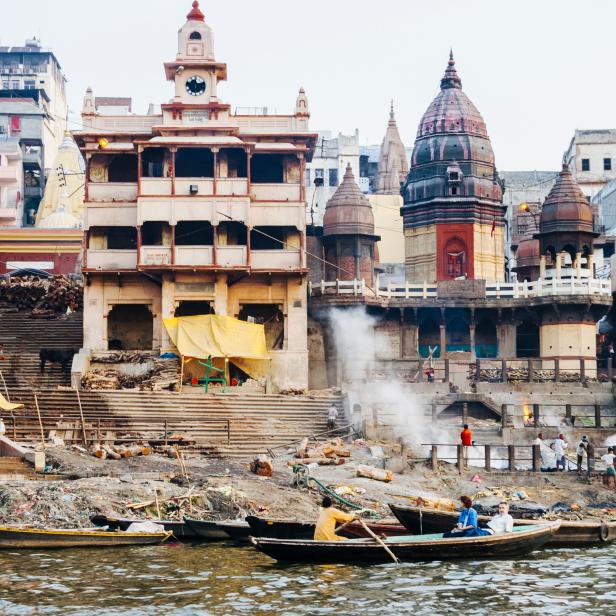
It gets mildly better as tributaries dilute the effects of industry further downstream. In the holy city of Varanasi, one of the oldest in the world, Hindu pilgrims and tourists from all around the country not only flock to the river to pray to it but immerse ashes of their cremated loved ones into the flowing water. The belief is that it will help the soul attain salvation by virtue of its purity. However, corpses sometimes don’t fully disintegrate before they are immersed and - don’t picture this - they are left half-burnt and floating in the river.
Large-scale plans have been launched to clean the river and India as a whole such as the ‘Swacch Bharath Abhiyan’ and ‘Nemami Gange’ plans but critics say that the cleaning has been superficial. The Ganges still carries several pollutants that cannot be simply swept away or eaten by flesh-eating turtles as they once tried in the 1980s. One of the biggest problems is more basic - there seems to be a lack of a clear-cut understanding of what pollutants are actually in the water and how they affect it.
Dipro Sarkar is a Ph.D. student at the Indian Institute of Technology, Kanpur who has been working with his professor Dr. Rajiv Sinha on high-tech solutions to the first survey and analyze the pollutants—a step they say is necessary before any large or long-term cleaning scheme can make a difference. “Understanding the chemical components in each pollutant and tracing its source is the logical place to begin,” says Dipro, who worked on a pilot project to send a four-seater Cessna plane into the sky, fitted with four multispectral cameras that use monochrome sensors to monitor pollutants in the river. “When pollutants are discharged into [the] river, they create a long pathway that we call pollution plumes,” he explains. “And these are what we study from the sky. Traditional water quality monitoring methods are often unreliable and inadequate. Given the large scale of river systems, the remote sensing method offers a more reliable and comprehensive alternative for water quality monitoring.” Supported by Ministry of Human Resource Development, as well as WWF-India, the team sent their first plane up in 2016, which began to collect data on the water composition.
“The reflection of light from the surface of the liquid in a water body depends on the amount of soluble and insoluble matters in it. At a higher concentration, these changes are visible to the naked eye, but in low concentrations, we use specialized optical filters and algorithms to isolate the wavelengths of light being reflected,” Dipro explains. They create false color composite images, which adds color to the wavelengths to better represent them, and help the team distinguish between the different parts of the river with varying concentrations of suspended pollutants and sediments. “Once we can trace them back to the sources accurately, we have more to then hold the culprits accountable,” says Dipro.
After the success of their pilot, Dipro and Dr. Sinha have been asked by the ministry to develop this further so they can deal with polluters better. Dipro says, “With new and cheap drones available in the market, anyone can send one up and help us add to our bank of information. The problem is now enforcement and more people must get involved with drones and drive to push for better laws and a cleaner environment. The future is here - and that is using the best available technology and the power of coming together to solve our biggest social and environmental problems.”