


Curiosity Daily Podcast: Astronauts Grew Lettuce in Space, Why Smelling a Dirty Shirt Can Help You Sleep, and Early Animals That Acted Like an Ancient Internet
Learn about how your lover’s clothing could improve your sleep; how astronauts grew vegetables in space for the first time; and ancient animals that were connected by a crude version of the internet.
April 02, 2020
Episode Show Notes:
Smelling your lover’s shirt could improve your sleep by Kelsey Donk
- 3 Reasons to Give Your Valentine a Smelly, Unwashed T-Shirt. (2020). Psychology Today. https://www.psychologytoday.com/us/blog/the-athletes-way/202002/3-reasons-give-your-valentine-smelly-unwashed-t-shirt
- Smelling your lover’s shirt could improve your sleep. (2020, February 13). UBC News. https://news.ubc.ca/2020/02/13/smelling-your-lovers-shirt-could-improve-your-sleep/
- Reed, D. L., & Sacco, W. P. (2016). Measuring Sleep Efficiency: What Should the Denominator Be? Journal of Clinical Sleep Medicine : JCSM : Official Publication of the American Academy of Sleep Medicine, 12(2), 263–266. https://doi.org/10.5664/jcsm.5498
We grew lettuce in space! by Grant Currin
- Space lettuce. (2020). EurekAlert! https://www.eurekalert.org/pub_releases/2020-03/f-sl022720.php
- Khodadad, C. L. M., Hummerick, M. E., Spencer, L. E., Dixit, A. R., Richards, J. T., Romeyn, M. W., Smith, T. M., Wheeler, R. M., & Massa, G. D. (2020). Microbiological and Nutritional Analysis of Lettuce Crops Grown on the International Space Station. Frontiers in Plant Science, 11. https://doi.org/10.3389/fpls.2020.00199
- What do astronauts eat in space? (2019, April 28). Royal Museums Greenwich. https://www.rmg.co.uk/discover/explore/space-stargazing/space-exploration/what-do-astronauts-eat-in-space
Half-billion-year-old fern-like animals acted like an ancient internet by Cameron Duke
- Half billion-year-old “social network” observed in early animals. (2020). EurekAlert! https://www.eurekalert.org/pub_releases/2020-03/uoc-hb030320.php
- Quaglia, S. (2020, March 5). Half-billion-year-old, fern-like animals may be the first social network. Inverse; Inverse. https://www.inverse.com/science/ancient-fern-animals-may-be-first-social-network
- Liu, A. G., & Dunn, F. S. (2020). Filamentous Connections between Ediacaran Fronds. Current Biology. https://doi.org/10.1016/j.cub.2020.01.052
- Taylor, J. W., Hann-Soden, C., Branco, S., Sylvain, I., & Ellison, C. E. (2015). Clonal reproduction in fungi. Proceedings of the National Academy of Sciences, 112(29), 8901–8908. https://doi.org/10.1073/pnas.1503159112
Subscribe to Curiosity Daily to learn something new every day with Cody Gough and Ashley Hamer. You can also listen to our podcast as part of your Alexa Flash Briefing; Amazon smart speakers users, click/tap “enable” here: https://curiosity.im/podcast-flash-briefing
Next Up

Get Ready for Puppy Bowl XXII on Animal Planet!
Puppy Bowl XXII premieres Sunday, February 8, 2026, at 2:00PM ET/11:00AM PT with more adoptable puppies from shelters and rescues than ever before.

Get Ready for Puppy Bowl XXI on Animal Planet!
Puppy Bowl XXI premieres Sunday, February 9 at 2P ET/11A PT with more adoptable puppies from shelters and rescues than ever before.

Scientists Watch as Stars Quake
The European Space Agency’s Gaia spacecraft has managed to watch stars tremble, their light subtly changing as starquakes ripple through their surfaces. Which is pretty cool, because Gaia wasn’t even designed to do it.
Get Ready for Puppy Bowl XX on Animal Planet!
Puppy Bowl XX premieres Sunday, February 11 at 2P ET/11A PT with more adoptable puppies from shelters and rescues than ever before.
Shipwrecked & Surrounded by Sharks
This week, we do things a little differently, as Shark Week’s Luke Tipple invites Adventure Aaron into the podcast studio to talk about his incredible near-death experience on the open water. Adventure Aaron gets into what it takes to circumnavigate the world in an ocean rowboat, what it’s like to stare eye-to-eye with an oceanic white tip that probably wants you for lunch, and everything else that happened to him when his boat was capsized, and he was lost by himself at sea.
Why We Know Nothing about Dark Matter and Dark Energy
Welcome to the era of precision cosmology…where we’ve managed to very precisely measure everything we don't know about the universe.
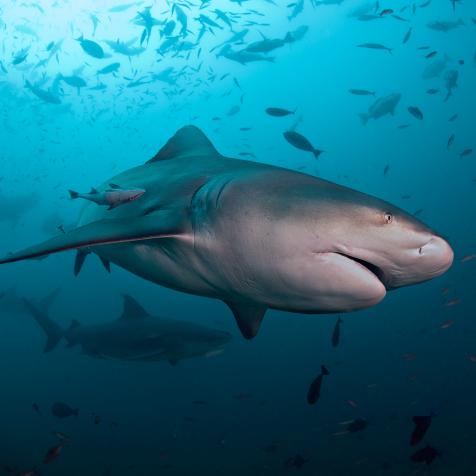
Shark Week: The Podcast - What is the Status of Sharks in our Oceans?
In this season’s final episode, Luke welcomes Emmy-winning filmmaker and conservationist Shawn Heinrichs to discuss the state of sharks in the ocean. They go over how both legal and illegal fishing operations are decimating the ocean’s wildlife, what it’s like to have a hit put out on you for exposing criminal enterprises to the world, and whether or not NOAA’s data on “sustainable” fishing can really be trusted.
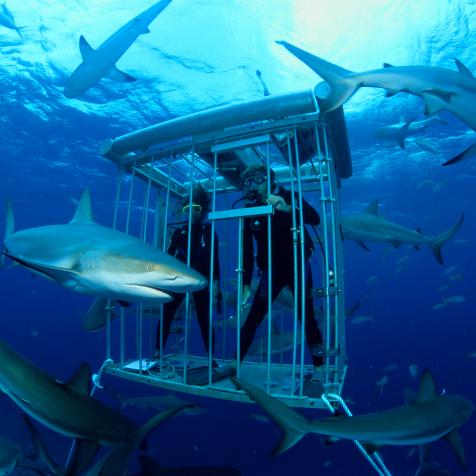
Shark Week: The Podcast - Superstar Kesha Lifts the Gag Order on Saving Sharks
Pop superstar Kesha joins Shark Week’s Luke Tipple on the podcast to discuss her love of sharks, how her music funds her addiction to diving, and how you can find inner peace while under the water. And at the end, our researcher Sierra drops in to tell us that some sharks have teeth in their eyes.

A Guide to Defending the Earth
Let’s say one day astronomers announce that our worst nightmare has come true: a large object is headed towards the Earth with a significant chance of impact. What do we do?


An Astronomical Review of “Don’t Look Up”
In our annual New Year’s family tradition of struggling to stay awake until midnight, we decided to watch “Don’t Look Up,” the Adam McKay satire starring Leonardo DiCaprio, Jennifer Lawrence, and other fabulously good-looking people.