


Articles
Showing 61 - 75 of 2,638 results

Shark Week: The Podcast - How Many Sharks Are Yet to Be Discovered?
Luke Tipple is joined by Shark Week host and all-around adventurer Forrest Galante. They discuss his upcoming special Alien Sharks: South Africa, Forrest’s remarkable talent for finding creatures once believed to be extinct, and how many shark species may still be unknown. Then, our researcher Sierra stops by to tell us about the world’s most prehistoric shark.

Shark Week: The Podcast - How To Have A Career in Shark Science
Shark Week’s Luke Tipple tackles the question “How can I work with sharks?” alongside two experts in the field – and their answers are not always the obvious ones. Luke is joined first by Kelly Link, Associate Curator of the Georgia Aquarium who talks about what it’s like to be an aquarist, how it differs from field work, and how to get yourself noticed. The second guest is Dr. Neil Hammerschlag who goes into detail on what it takes to become a prominent scientist, and what other paths you can take if a PhD isn’t for you. And at the end, researcher Sierra stops by to tell us about the world’s smallest shark.

Shark Week: The Podcast - Do You Have the Guts to Be a Shark Handler?
Host Luke Tipple welcomes a pair of divers – Leigh Cobb and Josh Eccles – who have taken their passion for sharks and turned it into a dangerous career. They explore what it takes to swim with sharks for a living, then go into common myths and facts on what to do in the open water – if you ever come face to face with a shark. Plus, our researcher Sierra drops by with a new species of shark discovered in the freezing depths of the ocean.

Shark Week: The Podcast - Superstar Kesha Lifts the Gag Order on Saving Sharks
Pop superstar Kesha joins Shark Week’s Luke Tipple on the podcast to discuss her love of sharks, how her music funds her addiction to diving, and how you can find inner peace while under the water. And at the end, our researcher Sierra drops in to tell us that some sharks have teeth in their eyes.

Shark Week: The Podcast - How Smart Are Sharks?
The discussion turns this week to sharks’ intelligence, and how it varies among species. Host Luke Tipple is joined by Dr. Tristan Guttridge, a behavioral ecologist and veteran of Shark Week whose research has tackled the social smarts, and even personalities, of different kinds of sharks. He sheds light on why we shouldn’t just think of them as dumb fish with rows of razor-sharp teeth. And at the end, our researcher Sierra Kehoe tells us about shark hypnosis.

Shark Week: The Podcast - Do Scientists Need to Kill Sharks?
Host Luke Tipple welcomes two guests to discuss how researchers can kill sharks in the name of science – and whether they need to at all. The first is Dr. Neil Hammerschlag, shark researcher and founder of Atlantic Shark Expeditions, and an expert on data-gathering in the field. He’s followed by explorer Fred Buyle, a world-record-breaking freediver whose innovative methods of shark tagging are explored. Plus, our researcher Sierra tells us about how a 50-year study changed our understanding of tiger sharks – and much of the work wasn’t even done by scientists.

Shark Week: The Podcast - Lights! Camera! TEETH! Making Shark Docs
Shark Week’s Luke Tipple is joined by longtime filmmaker and Emmy-award-winner Andy Casagrande. He’s filmed and appeared in dozens of shark documentaries, and might just be the most prolific shark cinematographer in history. He talks with Luke about his career, the contentious term “shark porn,” and the future of the industry. And at the end, our researcher Sierra talks about the unprecedented ways that sharks are currently endangered.

Shark Week: The Podcast - How Did a Shark Encounter Survivor Become an Advocate for Their Protection?
Shark Week’s Luke Tipple welcomes professional photographer Mike Coots, who lost his leg to a tiger shark attack when he was only 18. But after his horrific injury, he came to love sharks, and became a lifelong advocate for their safety. Luke and Mike discuss his career, his love for photographing sharks, and how to positively approach the big life-changing moments that can happen to any of us.
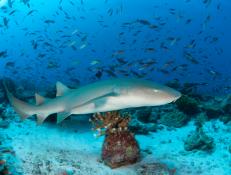
Shark Week: The Podcast - How Shark Fishing Funds Human Trafficking
Luke Tipple is joined by Pulitzer Prize-winning journalist and author of the Outlaw Ocean Ian Urbina, who has dedicated his life to chronicling crime on the high seas. They discuss the state of our world’s oceans, how nearly 20% of your seafood was likely caught illegally, and the surprising link between modern slavery and the killing of sharks.

Curiosity Daily Podcast: Fading into Memories, Music for the Mind, Air Diamonds
Today, you’ll learn about how doctors may have accidentally confirmed that our lives do flash before our eyes just before death, the scientists aiming to legitimize art and music therapy as treatment for mental trauma, and how scientists are pulling diamonds out of thin air! ... Essentially.

Curiosity Daily Podcast: Dirty Disinfectant, Hot Iron Blobs, Infinite Versions of You
Today, you’ll learn about how some cleaning products in your kitchen may be terrible for the environment even though they’re labeled “green,” hot blobs of iron playing games with Earth’s magnetic field, and how some far-out theories in physics predict there are infinite versions of you.

Curiosity Daily Podcast: Otterly Amazing, Let’s Go Bananas, Blingy Mayan Grills
Today, you’ll learn about the cutest warriors helping humans on the front lines in the fight against climate change, an important new study that reveals how you can add years to your life, yes… years, and an ancient Mayan dental practice that added some flashy bling to their teeth.

Curiosity Daily Podcast: Burn Them Cals, Magic of Mushrooms, Flying at Mach 16
Today, you’ll learn about some new, emerging data that is giving us surprising insight into human metabolism, how magic mushrooms are at the forefront of mental health treatment, and new jet technology that could get us anywhere in the world in under two hours.

Curiosity Daily Podcast: 5 Seconds to Sick, Animal Spidey Sense, Upset Pterosaur Tummies
Today, you’ll learn about the real science behind the five-second rule and why you may wanna reconsider eating that candy off the ground, why researchers are looking to our furry friends to build better early warning systems for natural disasters, and why the first animal to ever fly had a real issue keeping its lunch down.

Curiosity Daily Podcast: Zero G Romance, Our Sixth Sense, Oinking at A.I.
Today, you’ll learn about why studying human intimacy in space is necessary for humanity, the mysterious sixth sense human beings have, which is not seeing dead people, and how researchers used artificial intelligence to figure out a way to speak pig.