Sharks and Mermaids, oh my!

As I stood in waist-deep water, bouncing gently with each swell of the ocean, the two tourists next to me suddenly yelled “shark!” They retreated panicked toward the shore, as a kayaker nearby chuckled and shouted a quick lesson “Don’t worry, they don’t bite!”
This is a scene that plays out all day long to the uninitiated beach-goers who spot congregations of sharks swirling around them. Along the California coastline, and especially in La Jolla, California near San Diego, the harmless leopard sharks congregate in such massive numbers that it is considered one of the largest gatherings of leopard sharks in the world.
As a photographer passionate about shark conservation, this is a great opportunity to tell the story of co-existence through education. Seeing tens of thousands of people standing in knee-deep water to spot these beautiful creatures feeding in the soft sands is a visual representation of how our perception of sharks has changed through awareness and education. Knowing these leopard sharks are harmless to us, allows even the most nervous shark enthusiast an up-close encounter with the leopards, who get close enough to watch, but always keep at least arms length away.
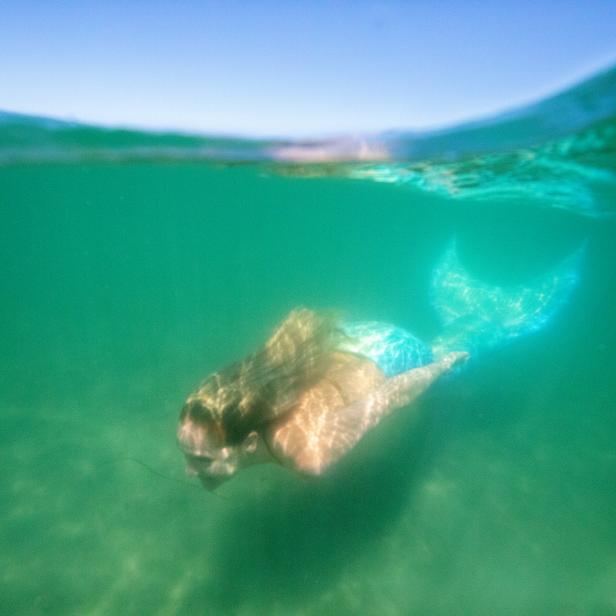
To help drive home the message of shark conservation and protection, I had a bit of an unusual idea. A dear friend of mine is a professional mermaid. That’s right…a mermaid. Sporting a 50 pound, custom-made silicone tail that she has to lube up her legs and wiggle into, leading ocean conservationist Linden Wolbert transforms herself into a mermaid to bring awareness to ocean conservation issues. So what do mermaids have to do with sharks?
Mermaids are a mythological creature that, more than likely, never existed. They swim only in our imaginations and in the legends and lore of our maritime past. My idea is to juxtapose a mermaid alongside this shark congregation to draw the parallel that without continued protection of our oceans and the species, sharks may one day become a myth themselves. If you stand on the shore as a mermaid is put into the ocean, you’ll instantly realize how beloved mermaids are by kids and adults alike, so it is also a great creative opportunity to drive imagination and teach people about these peaceful sharks on the California coast.
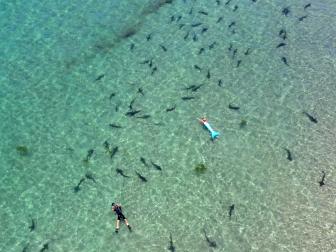
Using Drone Photography to Capture a Mermaid and Sharks 10 Photos
On the newest episode of Nature in Focus, Ian Shive teams up with a professional mermaid to photograph leopard shark congregations and raise awareness for shark conservation.Watch Shark Week on Discovery and discovery+.
Leopard shark numbers peak in August, swelling into the thousands. With my camera in an underwater housing, I first approached documenting the sharks at eye-level, dipping down into the sands where they feed on crabs, shrimp, octopuses and fish. I also tried to pair up the mermaid with the sharks, but the shallow water combined with lots of tourists feet and soft, churning sand, meant that visibility was extremely challenging. But when you can’t get good visibility from below, that usually just means you need to get up above!
Working with Trystan Snodgrass and Daina Buchner, as well as my team at Tandem Stills + Motion, we put three drones up into the air to try over the course of two days to help visualize this incredible gathering of sharks…and the mermaid at the center of it all! Sure enough, this top-down angle helped us get a better sense of the gathering of sharks, that I couldn’t truly appreciate from underwater due to visibility limitations. It’s funny how sometimes the water looks so clear from a drone, but then all the little particles floating around make it almost impossible to capture any real detail. I guess you could say it is a tale of two worlds!
Just like Shark Week kicks off the true start of summer, so does the arrival of these leopard sharks in California! I couldn’t think of a better way to get into a sharky mood than making beautiful images of this incredible wildlife phenomenon!