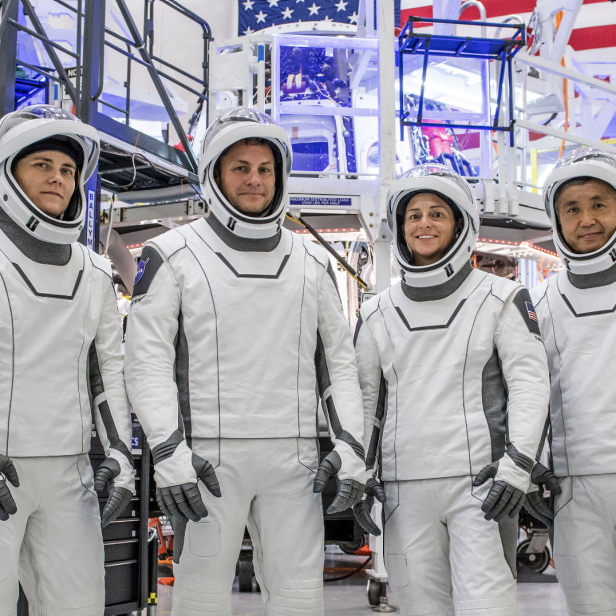
The four members of the SpaceX Crew-5 mission pose for a portrait in their Crew Dragon flight suits at SpaceX headquarters in Hawthorne, California. From left are, Mission Specialist Anna Kikina from Roscosmos; Pilot Josh Cassada and Commander Nicole Aunapu Mann, both from NASA; and Mission Specialist Koichi Wakata from the Japan Aerospace Exploration Agency (JAXA).

The four members of the SpaceX Crew-5 mission pose for a portrait in their Crew Dragon flight suits at SpaceX headquarters in Hawthorne, California. From left are, Mission Specialist Anna Kikina from Roscosmos; Pilot Josh Cassada and Commander Nicole Aunapu Mann, both from NASA; and Mission Specialist Koichi Wakata from the Japan Aerospace Exploration Agency (JAXA).

Photo by: SpaceX

SpaceX

The First Native American Woman Travels into Space with NASA's Crew-5 Mission

By: Discovery

NASA's SpaceX Crew-5 mission is headed to the International Space Agency with 4 astronauts led by Mission Commander Nicole Aunapu Mann.

October 01, 2022

Updated Oct 5, 2022

NASA's Commercial Crew Program is launching a crew of four astronauts on the fifth crew rotation mission to the International Space Station launched atop a Falcon 9 rocket from Florida's Kennedy Space Center Wednesday, Oct. 5 at noon EDT (rescheduled from Tuesday, October 4 at 12:23 pm ET).

Photo by: James Blair - NASA - JSC

James Blair - NASA - JSC

NASA’s SpaceX Crew-5 sends astronauts Nicole Mann and Josh Cassada of NASA, astronaut Koichi Wakata of JAXA (Japan Aerospace Exploration Agency), and cosmonaut Anna Kikina of Roscosmos, from Launch Complex 39A at NASA’s Kennedy Space Center in Florida to the ISS.

With this launch, mission commander, Nicole Aunapu Mann, has become the first Native American woman to travel to space.

Mann told Reuters "I feel very proud. It's important that we celebrate our diversity and really communicate that specifically to the younger generation." Mann is a member of the Wailacki of the Round Valley Indian Tribes.

Photo by: James Blair - NASA - JSC

James Blair - NASA - JSC

Crew-5 will spend roughly a day traveling to the ISS after launch. Once the new crew arrives, the members of the Crew-4 mission currently on the ISS will spend five days handing off duties to the new arrivals.

Once the handoff is complete, the astronauts of NASA's SpaceX Crew-4 mission will undock from the space station and splash down off the coast of Florida, concluding their long duration stay of around six months on the ISS.

The Crew-5 astronauts will live aboard the International Space Station for the next six months, conducting science experiments in areas including cardiac to prepare for human exploration beyond low-Earth orbit and to benefit life on Earth as well.

Next Up

Watch World-Class High Diver Molly Carlson Leap From a Helicopter Into a Shark Cage on 'Ultimate Shark Dive'

Plunge head-first into the most shocking Shark Week special yet! Learn all about it here.

Sing Along to the Shark Week Song

Listen to the first official Shark Week song and catch all the action July 26 through August 1 on Discovery!

Scientists Watch as Stars Quake

The European Space Agency’s Gaia spacecraft has managed to watch stars tremble, their light subtly changing as starquakes ripple through their surfaces. Which is pretty cool, because Gaia wasn’t even designed to do it.

Why We Know Nothing about Dark Matter and Dark Energy

Welcome to the era of precision cosmology…where we’ve managed to very precisely measure everything we don't know about the universe.

A Guide to Defending the Earth

Let’s say one day astronomers announce that our worst nightmare has come true: a large object is headed towards the Earth with a significant chance of impact. What do we do?

An Astronomical Review of “Don’t Look Up”

In our annual New Year’s family tradition of struggling to stay awake until midnight, we decided to watch “Don’t Look Up,” the Adam McKay satire starring Leonardo DiCaprio, Jennifer Lawrence, and other fabulously good-looking people.

Shark Week: The Podcast - How To Have A Career in Shark Science

Shark Week’s Luke Tipple tackles the question “How can I work with sharks?” alongside two experts in the field – and their answers are not always the obvious ones. Luke is joined first by Kelly Link, Associate Curator of the Georgia Aquarium who talks about what it’s like to be an aquarist, how it differs from field work, and how to get yourself noticed. The second guest is Dr. Neil Hammerschlag who goes into detail on what it takes to become a prominent scientist, and what other paths you can take if a PhD isn’t for you. And at the end, researcher Sierra stops by to tell us about the world’s smallest shark.

Shark Week: The Podcast - Do Scientists Need to Kill Sharks?

Host Luke Tipple welcomes two guests to discuss how researchers can kill sharks in the name of science – and whether they need to at all. The first is Dr. Neil Hammerschlag, shark researcher and founder of Atlantic Shark Expeditions, and an expert on data-gathering in the field. He’s followed by explorer Fred Buyle, a world-record-breaking freediver whose innovative methods of shark tagging are explored. Plus, our researcher Sierra tells us about how a 50-year study changed our understanding of tiger sharks – and much of the work wasn’t even done by scientists.

Nature from Above: The Art of Aerial Photography

I’ll never forget the first time I went up in a small plane. Technical considerations aside, I had a million thoughts going through my mind.

Quiz: Test Your Space Exploration Knowledge

Ahead of the historic May 27th NASA and SpaceX crewed space launch, test your space exploration knowledge!

Related To: