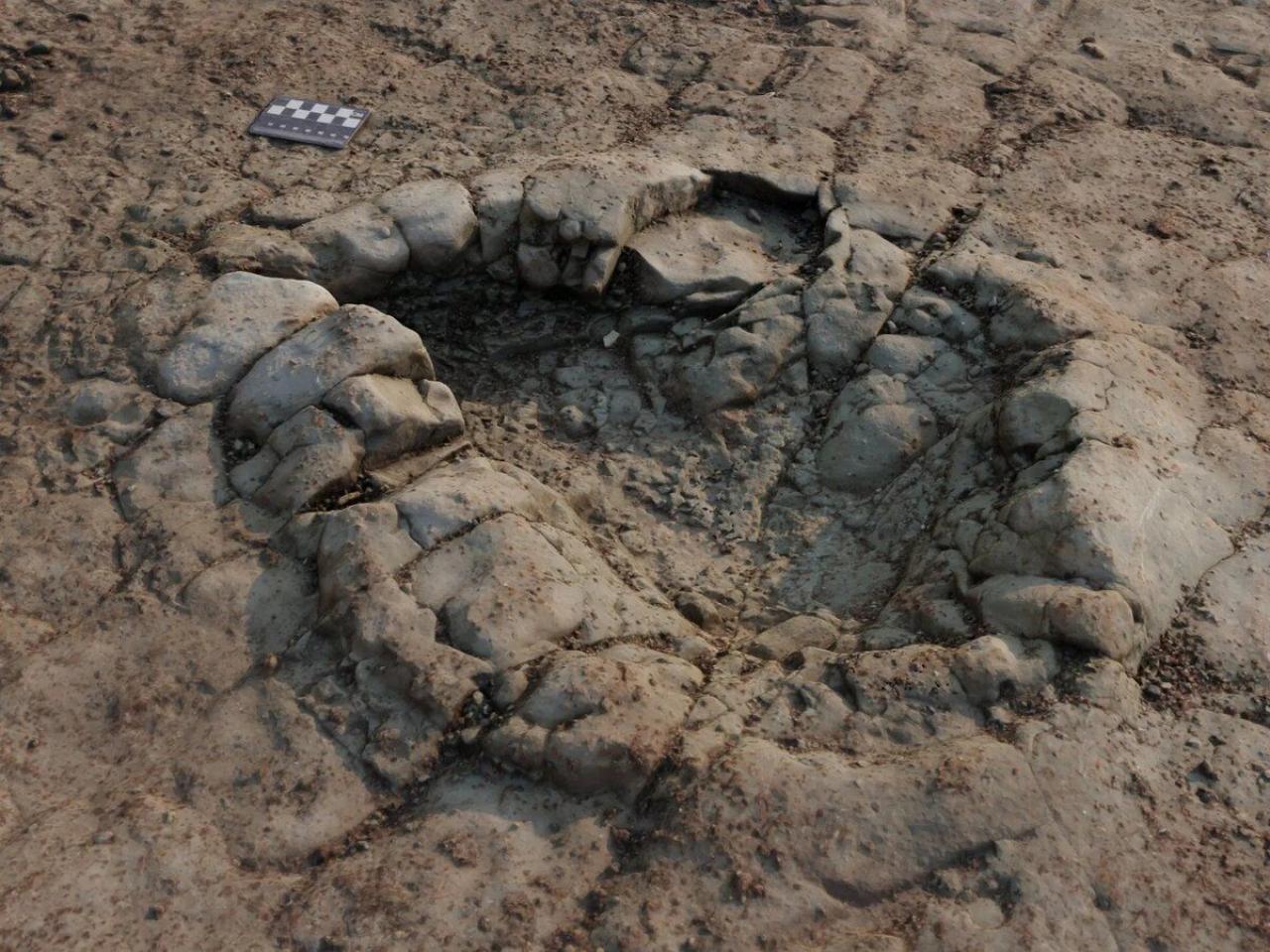
Photo by: Peter Falkingham/Natural History Museum

Peter Falkingham/Natural History Museum

Dinosaur Footprints from 200 Million Years Ago Discovered in Wales

Members of the public found the former dinosaur “trampling grounds” while at the beach in South Wales.

January 04, 2022

On a beach in Wales, footprints were discovered that scientists believe came from a prehistoric dinosaur some 200 million years ago.

Paleontology experts from London’s Natural History Museum helped lead a study of the tracks, published in Geological Magazine. The prints likely belong to early sauropods or a close relative to the species.

"We believed the impressions we saw at Penarth were consistently spaced to suggest an animal walking. We also saw displacement rims where mud had been pushed up. These structures are characteristic of active movement through the soft ground," Professor Paul Barrett said in the museum’s announcement of findings.

The footprints were found on a beach in Penarth, South Wales by members of the public and first reported to the museum in 2020. They’re believed to date back to the Triassic period, between 201-237 million years ago.

"We know early sauropods were living in Britain at the time," said Dr. Susannah Maidment, a paleontologist at the museum.

The tracks cover an area about 164 feet long, and each footprint measures about 1.6 feet long. The volume of prints indicates the area was a “trample ground” for dinosaurs.
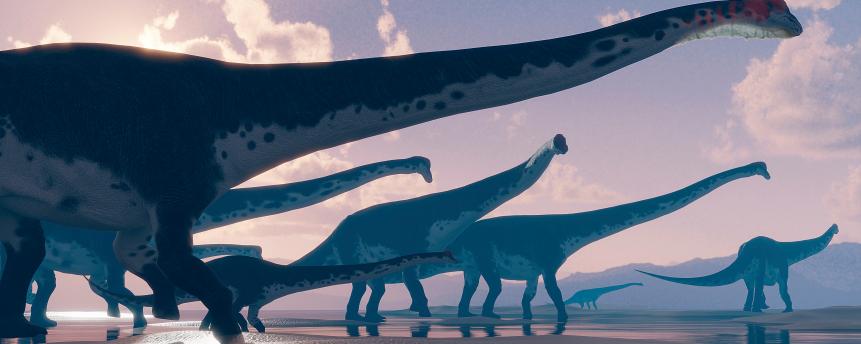
Artwork of a community of titanosaurs. The titanosaurs were a diverse group of sauropod (long-tailed, long-necked) dinosaurs that lived throughout the Mesozoic era. They were the last surviving sauropods, before being wiped out in the mass extinction at the end of the Cretaceous period. The group includes the largest animals ever known to have walked the Earth, with lengths of 30-40 metres and weights up to several dozen tonnes. The largest known among these animals are argentinosaurus and dreadnoughtus, from what is now Argentina, although their remains are very sparse.

1301755045

Digital animation of a herd of sauropods, the dinosaurs believed to have left the tracks at the South Wales beach.

Photo by: MARK GARLICK/SCIENCE PHOTO LIBRARY

MARK GARLICK/SCIENCE PHOTO LIBRARY

Digital animation of a herd of sauropods, the dinosaurs believed to have left the tracks at the South Wales beach.

"These types of tracks are not particularly common worldwide, so we believe this is an interesting addition to our knowledge of Triassic life in the UK. The record of Triassic dinosaurs in this country is fairly small, so anything we can find from the period adds to our picture of what was going on at that time," said Barrett.

Scientists hope this discovery will reveal information about the dinosaur’s migration patterns and behavioral qualities around how they walked.

The museum said the footprints, which are already highly weathered, will continue to remain at the beach until they are washed away by the shore.
Next Up

Everything You Need to Know About Rio de Janeiro Carnival

Rio de Janeiro is a really big deal. Brazil’s most famous festival - or ‘The Greatest Show on Earth’ as its organizers call it, attracts millions of people from all over the world to dance, enjoy music and party for days.

We Just Found One of the Earliest Fragments of the Merlin Legend, with a New Take

In a library in the UK, research librarians stumbled upon one of the oldest known manuscripts detailing the legend of Merlin. Translated from Old French, the accidentally discovered text offers a slightly augmented take on a typically risqué Arthurian legend.

Belize's Jungles are Wild, Mysterious and Full of Discovery

More than half of Belize, a Central American country with as many as 2 million indigenous Mayan inhabitants, is covered in dense, sprawling jungle – meaning the region has adventures galore for any traveler wishing to explore.

Costa Rica's Protected 'Shark Island' Will Save Thousands of Species

Costa Rica began the year with a fresh green start after its president announced new protections for the country’s unique biodiversity and wildlife species, expanding a national park by 27 times its size.

One of the Bermuda Triangle’s Greatest Mysteries May Have Been Solved!

While filming Shipwreck Secrets, Michael Barnette and his team believe they have located the SS Cotopaxi, a cargo ship that vanished without a trace almost 100 years ago. Shipwreck Secrets premieres Sunday, February 9 at 8p ET on Science Channel.

New Year, New Adventures: What the World has to Offer

With a new year comes new opportunities, and there’s no time like the present to start learning more about parts of the world you’ve never dreamed of before. Please review and follow all state and local guidelines while traveling. Updated December 17, 2021

3,000-Year-Old Lost City Found in Egypt

3,000-year-old city of Aten has been discovered to be the next best “extraordinary” finding since the tomb of boy king Tutankhamen.

Kwanzaa: The African Celebration of Unity and Culture

Kwanzaa may be a festival celebrated by millions of African Americans and pan-Africans, but it has only been around for a few decades. Introduced to the United States in 1966 as a ritual to welcome the first harvest to the home, the festival, which takes place from December 26 to January 1, is a celebration of life, unity, family, and culture.

Found: Perfectly Preserved Dinosaur Skull

Bucky gets lucky with a new fossil discovery. A North Carolina State University paleontologist finds his dream fossil in the sands of the New Mexico desert.

Celebrating Diwali Traditions

Diwali is a Hindu festival that occurs every year in autumn during the month of Kartik - which to us Westerners corresponds to mid-October to mid-November.