Behind the Scenes with Shark Week’s Tiger Queen
Kinga Philipps, diver and filmmaker, talks close encounters, free diving with tiger sharks and the evolution of women in exploration.
Stream TIGER QUEEN and more exclusive Shark Week content now on discovery+.
For two days, a team of researchers bobbed in the waters of the Turks and Caicos waiting on a prize some said would never come. There, a remote population of tiger sharks only rumored to exist, evaded their search. In TIGER QUEEN, the fruits of the team’s efforts are unveiled on the discovery+ exclusive. Journalist Joe Sills sat down with the TIGER QUEEN host to talk tiger sharks, conservation, and what it's like to be a leading woman on Shark Week.

Kinga Philipps reflects on all she’s learned during her search for male tiger sharks in Turks and Caicos.
Joe Sills: Shark Week has more women hosts and celebrity guests this year than ever before. What does being the face of TIGER QUEEN mean to you?
Kinga Philipps: This is something I have wanted for a really long time. For me, it’s such an honor because there have been amazing women celebrities and scientists before.
I love this fit so much, because I have worked in TV for 20 years. I have worked in shark conservation for a decade. So, it was a natural fit to host a show, because I am really here to further the narrative about tiger sharks.

Behind the Science of Tiger Queen 7 Photos
The shark population in Turks and Caicos has a sizable concentration of female tiger sharks, leaving scientists wondering where all the males are hiding. Shark enthusiast Kinga Philipps joins Dr. Austin Gallagher to help solve this puzzling mystery.Dr. Austin Gallagher is the Chief Executive and lead scientist at Beneath the Waves. He gives us the inside scoop on what happened out on the water while shooting TIGER QUEEN.Stream TIGER QUEEN exclusively on discovery+.
Joe Sills: Why tiger sharks? Was there a moment that set TIGER QUEEN in motion? A moment you fell in love with tiger sharks?
Kinga Philipps: There was a moment about 15 years ago off the coast of Oahu. I was diving, surrounded by sandbar sharks and Galapagos sharks. The water was warm and the morning light was filtering in through the waves. It was beautiful.
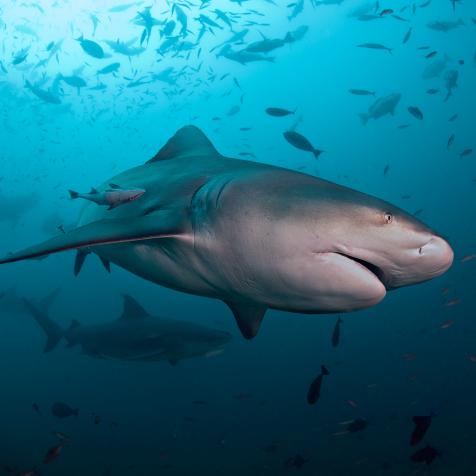
Our group was ooh’ing and aah’ing at all of the sharks around us when my heart skipped a beat. Suddenly, the sharks all cleared out. If you know sharks, you know that they usually only do that when something bigger is rolling in. There was this calm before the storm, then a gorgeous female tiger shark rolls right up to me. I remember my jaw dropping. She looked like a freight train, and the other sharks we had just seen looked like go-karts in comparison.
I’ve been in the water with great whites, with oceanic white tips and great hammerheads, too. But there is something about tiger sharks and the way they move as they approach you. They are graceful. They are extraordinary.

Kinga Philipps dives in the waters of Turks and Caicos looking for male tiger sharks.
Joe Sills: You’ve filmed shows in the past like Travel Channel’s LOST IN THE WILD. You do some intensive investigative work, but TIGER QUEEN introduces science to the table. What changes when you make scientific research part of the equation?
Kinga Philipps: First, you are playing by nature’s rules. You are in the water sunrise to sunset, eight hours a day. From a filming standpoint, it’s chaos.
In a show like TIGER QUEEN, nothing can be scripted, because the entire narrative is written by the sharks, their behavior and the science we are putting on the table.

Dr. Austin Gallagher and Kinga Philipps talk about the missing male tiger shark population and where it might have gone.
Joe Sills: Shark conservation is an important part of Shark Week. Can you tell us how filming TIGER QUEEN might contribute to the health of tiger sharks as a whole?
Kinga Philipps: The conservation element is a huge focus for my work with Shark Allies. What our research there says is that to protect sharks, we basically have to establish game reserves like you see for rhinos and gorillas. Shark populations are dwindling and creating those reserves can protect them.
No tiger sharks have ever been tagged in Turks and Caicos before. We hope we were step one in trying to protect them there. If you study the sharks and show where populations exists, you can work with local governments and people to begin the necessary steps to protecting the sharks and enforcing those protections. It’s all extraordinarily exciting from a conservation standpoint.

Joe Sills: There’s a moment with you in the water, face-to-face with a tiger shark. You’re holding it at bay with your hand. Can you break down what’s happening there?
Kinga Philipps: It looks like that, but the reality is that when I have a tiger shark coming into me, I need that shark’s focus to be right on my chest. When one comes in, I go vertical in the water so that it sees I am big and that I am not a fish. I want it to come towards my hand so that I can move it rather than allowing it to dip down and go for my legs or fins.
We aren’t on the menu for sharks, but when you are in the water with them, there are specific behaviors that you want them to see. You want them to know you have an eye on them and that you aren’t food.

Kinga Philipps and Dr. Austin Gallagher search the map for where the male tiger sharks may be hiding.
Joe Sills: How do you think TIGER QUEEN could help change the way gender roles are perceived in exploration and diving?
Kinga Philipps: The honest answer is that women have been prominent in exploration, science, and diving for a long time. Some of the most badass women—like Sylvia Earle and Stefanie Brendl—are out in the field and have been out there for a very long time. The reason that your question extends to media is because those women are not often publicized. There are incredible women in science, shark diving, exploration, journalism and adventure, but what is different now is that they are being highlighted more and more.
The benefit of that, and shows like this, is that all of the little girls out there watching get to see those women diving and exploring and swimming with sharks. They realize it is possible for them, too. It gives them something to aspire to.
I think this show is inspiring not because women are suddenly leading the way, but because it is being showcased.