Tyler Maddox
Jim Belushi Opens Up About His New Career High in the Cannabis Industry
Learn more about his upcoming Discovery show, GROWING BELUSHI, from Jim Belushi himself in this exclusive interview with Discovery.com
With an entertainment career spanning more than 40 years, Jim Belushi has carved an acclaimed career as an actor, comedian, singer, and dancer.
But there’s a side of him many fans don’t know about – his work as a legal cannabis farmer.
In honor of his upcoming Discovery show, GROWING BELUSHI, Belushi spoke with Discovery.com about his career, advocacy, and the impact marijuana has made on his life both personally and professionally.
Discovery (D): What made you want to go into the legal cannabis industry and when did you establish Belushi’s Farm?
Jim Belushi (JB): I established Belushi’s Farm in 2015, in the middle of the Banana Belt in Southern Oregon. The Banana Belt is a geographic handprint shaped like a banana leaf, where it is the perfect storm of air, sun, water, and temperatures to produce the best pears, grapes, and cannabis. I had thirteen acres on the Rogue River, a beautiful, spiritual spot between Mt. McLaughlin and across the river from Table Rock.
Jenniferchisumphoto
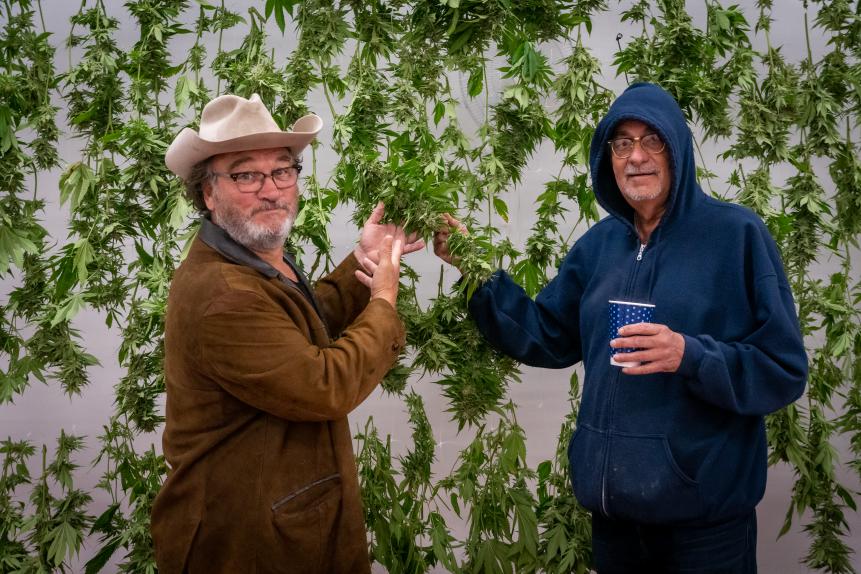
Jim and Chris showing off "Blue Dragon"
The property behind me was an 80-acre farm owned by Becca, who I became very close with. She became like a sister to me. I loved her deeply. Unfortunately, she became ill and slowly and tragically passed away. Her wish was for me to buy the property, so I did. I had 80 acres of land… what am I going to do with it? Grow hay? Alfalfa? Raise cattle? And that year, cannabis became legal in Oregon and I thought, what the hell, it’s the new agriculture of Oregon.
D: When did you first realize the medicinal and psychological benefits of cannabis?
JB: I was on the West coast of Oregon in Coos Bay at a dispensary visit. There were many people lined up. I always try to shake everybody's hand before I get into the dispensary for our formal sales, photos, and signatures. There was a skinny gentleman with long hair and deep blue eyes who stared right through me to my soul. I said, “Are you alright?” and he said, “I was a medic in Iraq and I saw things that happened to the human body that nobody in their lives should ever witness. They tell me I have triple PTSD, whatever that means. They prescribed all kinds of heavy drugs. I got off them, but I struggled with talking to my wife and my children and I couldn’t sleep. Your Black Diamond OG is the only strain that allows me to talk to my wife, my children, and to sleep.”
That was the moment when my heart opened, and my eyes were available to see all the veterans and people who have suffered. And there are many, many stories, including my own. For the PTSD that I suffered from my brother’s own drug overdose, the small microdosing that I do of cannabis helps my nerves and continues to open my consciousness to healing.
D: Has your career in the entertainment industry helped you in this venture?
JB: I love the magic of acting on stage, singing in front of an audience with The Blues Brothers, movies, television, directing. And I enjoy the magic of agriculture on Belushi’s Farm. We always bring forward all our knowledge into each thing we do, so it was natural for me to bring a camera to the farm and discover a show around it — a show that will help educate, inform, delight, and heal. It was a natural blend of two different worlds for me.
Tyler Maddox
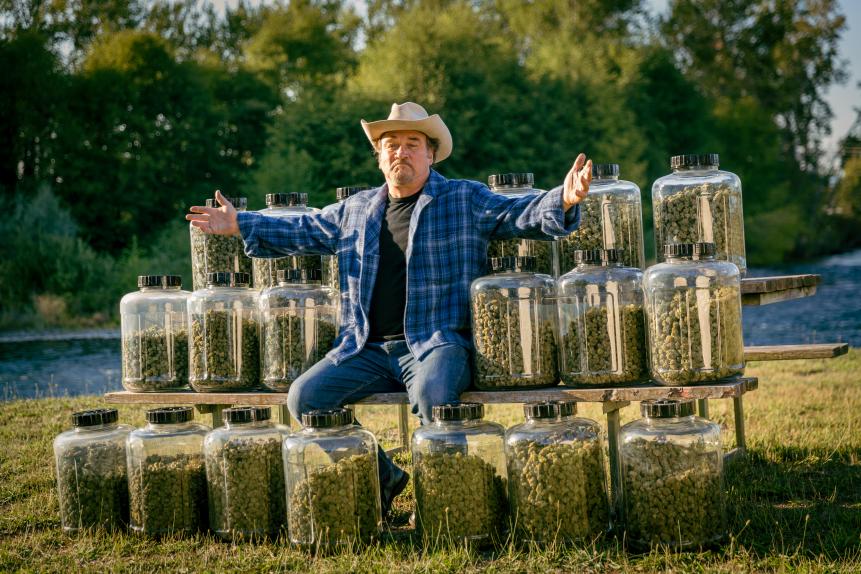
The man and his harvest.
D: Can you tell us about your involvement with The Last Prisoner Project and your work in marijuana law reform and ending cannabis criminalization?
JB: There are 40,000 cannabis prisoners in the US alone who have been incarcerated for doing something that is no longer a crime in many states, and something that thousands of others are legally profiting from by doing the same actions that got these people convicted. Communities of color are subject to disproportionate marijuana enforcement practices. Everybody now has the privilege to sell and consume cannabis legally and we have an opportunity to make sure that every single cannabis prisoner is released. Last Prisoner Project is working on clemency, reentry, and advocacy.
D: What is GROWING BELUSHI about and what inspired you to make it?
JB: It’s called GROWING BELUSHI, it’s not called GROWING POT. It’s about many things. It’s very layered. Of course, we go through the process of growing cannabis, from the soil to the perfect pH in the water to the nutrients, the feeding, the pruning, the harvesting, curing, trimming, selling, marketing, and the healing. The show is also about the difficulties and the challenges with everything that cannabis brings: legal compliance, tax laws, business, testing, and of course safety.
D: What’s your favorite strain or type of Belushi’s Farm cannabis?
JB: My favorite cultivar is Cherry Pie, which has become our most popular. I like it because the THC content is 18-19%. It has a little CBD in it. And it has 3-4% terpenes, which are the flavoring and taste. These three elements together because what is called an entourage effect. There’s no anxiety or paranoia. It’s just a very chill, friendly experience. I like it because I can still be social, articulate, and —my wife says — charming. I call it “The Marriage Counselor.”
D: What do you want Discovery audiences to get out of GROWING BELUSHI?
JB: An understanding of the safety and wellness aspects of cannabis. Cannabis helps with Alzheimer’s, seizures, headaches, psychological disorders, PTSD, chronic pain, cancer, Parkinson’s, backaches, and headaches. It also stimulates creativity, enhances the sounds of music and the tastes of food and the touch of your lover’s skin. It brings a feeling of joyfulness, euphoria, generosity of spirit, and kindness.
Don’t forget to catch GROWING BELUSHI Wednesday, August 19 at 10P, and keep up with the show by following #GrowingBelushi on social media. To learn more about Belushi’s Farm, visit its official website.