
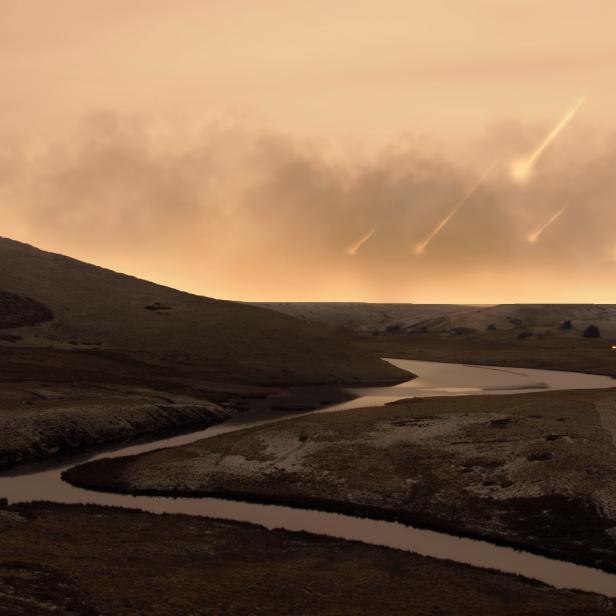
David Wall
Raining Sulfur in the Biblical City of Sodom Could Be Explained by an Impact Event
About 3,600 years ago, Tall el-Hammam was a bustling city-state in the Jordan Valley near the Dead Sea. It thrived for 1,500 years — until a devastating event destroyed the city and contaminated the surrounding farmland with salt. What had once been an extremely fertile area became completely barren overnight. Humans left the region for at least 500 years afterward, and researchers have struggled to explain what happened.
Now they think they’ve figured out an…otherworldly explanation. And one that matches an ancient story you might have already heard. Some historians have suggested the disaster parallels the biblical account of the destruction of the city of Sodom — one of the two cities in the Old Testament that were said to have been destroyed by God.
And destroyed it was. Tall el-Hammam was surrounded by a mudbrick wall that was 13 feet thick and 100 feet high. But almost all of the wall had been sheared off. And within the ruins, they found melted shards of pottery and precious metals, all covered with salt-heavy ash.
They also found some strange materials: shocked quartz, a material that’s common in nuclear bomb testing sites; tiny spheres containing iron and silica called spherules; and nano-scale diamonds. For these odd materials to form, the temperature would have been over 2,000 degrees Celsius, the surface temperature of a small red dwarf star!
So what happened? These signs pointed to some kind of extremely high energy, high-temperature event. Scientists think it was a cosmic airburst caused by a large meteor exploding in the air above the city.
Cosmic airbursts happen all the time, but they’re usually small. When a meteor enters Earth’s atmosphere, friction from air molecules causes it to heat up. As the meteor hits the denser and denser air lower down in the atmosphere, it can become superheated and explode.
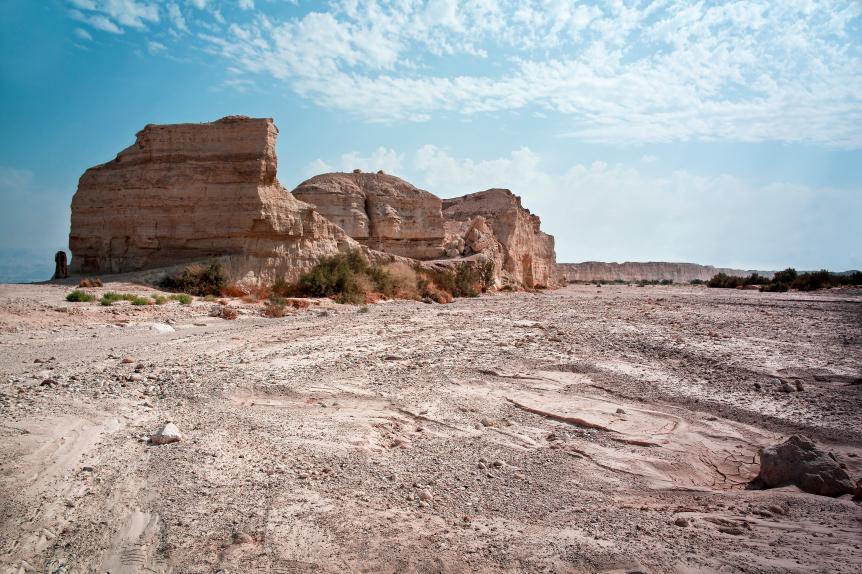
PHOTOSTOCK-ISRAEL/SCIENCE PHOTO LIBRARY
That’s what scientists think happened to Tall el-Hammam. Because of the extreme temperatures, it’s unlikely that the cause was an Earth-based phenomenon like an earthquake or volcanic eruption. And the technology at the time wasn’t advanced enough for the explosion to be human-made. So instead, scientists realized the most likely explanation was that it was a meteor. But since no impact crater was found, they figured a cosmic airburst fit the data best.
The research team realized that something about the cosmic airburst story sounded familiar, like the biblical story of the destruction of Sodom. The details of the story, such as fire and brimstone falling from the sky, seem to match what an eyewitness would have seen as a result of a cosmic airburst. Many archeologists and historians are debating whether the destruction of Tall el-Hammam might just be the source of this story. A 3,600-year-old mystery solved.
For more on this topic, listen to the Curiosity Daily Podcast
Discovery's award-winning Curiosity Daily podcast will help you get smarter about the world around you — every day. In less than 10 minutes, you’ll get a unique mix of research-based life hacks, the latest science and technology news, and more.