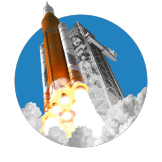
VAN HORN, TEXAS - JULY 20:  The New Shepard Blue Origin rocket lifts-off from the launch pad carrying Jeff Bezos along with his brother Mark Bezos, 18-year-old Oliver Daemen, and 82-year-old Wally Funk prepare to launch on July 20, 2021 in Van Horn, Texas. Mr. Bezos and the crew are riding in the first human spaceflight for the company.   (Photo by Joe Raedle/Getty Images)

VAN HORN, TEXAS - JULY 20: The New Shepard Blue Origin rocket lifts-off from the launch pad carrying Jeff Bezos along with his brother Mark Bezos, 18-year-old Oliver Daemen, and 82-year-old Wally Funk prepare to launch on July 20, 2021 in Van Horn, Texas. Mr. Bezos and the crew are riding in the first human spaceflight for the company. (Photo by Joe Raedle/Getty Images)

Photo by: Joe Raedle

Joe Raedle

Blue Origin's First Crewed Spaceflight Has Successful Liftoff and Landing

By: Discovery

This morning, on July 20, 2021, Blue Origin's first crewed spaceflight was a success! Congrats to Blue Origin founder Jeff Bezos and three crewmates, who lifted off into space from Blue Origin’s Launch Site near Van Horn, Texas. Here's the play-by-play of the New Shepard's approximitely 10 minute flight from launch to capsule landing, which looked picture perfect.

July 20, 2021

After years of meticulous planning, Blue Origin's first crewed spaceflight took off from a site in West Texas on Tuesday morning. This crew, included Blue Origin founder and Amazon CEO Jeff Bezos, Jeff's brother Mark Bezos, pioneering female pilot Mary Wallace “Wally” Funk, and college student Oliver Daemon. With this successful spaceflight, Funk (82) is now the oldest person to have flown in space and Daemon (18) the youngest.

VAN HORN, TEXAS - JULY 20: (----EDITORIAL USE ONLY â MANDATORY CREDIT - "BLUE ORIGIN / HANDOUT" - NO MARKETING NO ADVERTISING CAMPAIGNS - DISTRIBUTED AS A SERVICE TO CLIENTS----) Jeff Bezos along with his brother Mark Bezos, 18-year-old Oliver Daemen, and 82-year-old Wally Funk leave Blue Originâs New Shepard crew capsule after landing on July 20, 2021 in Van Horn, Texas. Mr. Bezos and the crew rode in the first human spaceflight for the company. (Photo by Blue Origin/Anadolu Agency via Getty Images)

VAN HORN, TEXAS - JULY 20: Jeff Bezos along with his brother Mark Bezos, 18-year-old Oliver Daemen, and 82-year-old Wally Funk leave Blue Originâs New Shepard crew capsule after landing on July 20, 2021 in Van Horn, Texas. Mr. Bezos and the crew rode in the first human spaceflight for the company.

Photo by: Anadolu Agency

Anadolu Agency

Congrats to Blue Origin and Jeff Bezos on this huge feat for commerical space flight. Today marks the first time in history that a commercial company launched a privately funded and built spacecraft from a private launch range with astronauts on board. This milestone helps inspire the next generation and open the doors of future space exploration for scientists, researchers, and everyday people who dream of traveling to space but aren't your traditional astronauts.

Here's how the events played out from launch to capsule landing.


Photos of Blue Origin's Journey to Space

Want more on the Blue Origin launch mission? At 10P ET tonight, Discovery will air a 1 hour special, JEFF BEZOS IN SPACE: BLUE ORIGIN TAKES FLIGHT, highlighting the morning’s event, along with interviews from after the launch, behind-the-scenes material, and background stories of Blue Origins and Jeff Bezos.

Follow Discovery on Facebook, Instagram, TikTok and Twitter for the latest updates and join the conversation on social media by using the hashtag #SpaceLaunchLive.

Next Up

Watch World-Class High Diver Molly Carlson Leap From a Helicopter Into a Shark Cage on 'Ultimate Shark Dive'

Plunge head-first into the most shocking Shark Week special yet! Learn all about it here.

Sing Along to the Shark Week Song

Listen to the first official Shark Week song and catch all the action July 26 through August 1 on Discovery!

A Guide to Defending the Earth

Let’s say one day astronomers announce that our worst nightmare has come true: a large object is headed towards the Earth with a significant chance of impact. What do we do?

Scientists Watch as Stars Quake

The European Space Agency’s Gaia spacecraft has managed to watch stars tremble, their light subtly changing as starquakes ripple through their surfaces. Which is pretty cool, because Gaia wasn’t even designed to do it.

Shark Week: The Podcast - Did Alien Tech Crash-Land into the Ocean?

Host Luke Tipple is joined this week by renowned Harvard professor, Dr. Avi Loeb, who recently led a deep-sea expedition to discover if evidence for advanced alien life crash-landed off the coast of Papua New Guinea in 2014. They discuss the recent Congressional UFO hearings, how the last seventy years of research into extraterrestrial life has been potentially misguided, and the challenges of searching for tiny objects on the bottom of the ocean.

Shark Week: The Podcast - How Shark Fishing Funds Human Trafficking

Luke Tipple is joined by Pulitzer Prize-winning journalist and author of the Outlaw Ocean Ian Urbina, who has dedicated his life to chronicling crime on the high seas. They discuss the state of our world’s oceans, how nearly 20% of your seafood was likely caught illegally, and the surprising link between modern slavery and the killing of sharks.

Shark Week: The Podcast - How Smart Are Sharks?

The discussion turns this week to sharks’ intelligence, and how it varies among species. Host Luke Tipple is joined by Dr. Tristan Guttridge, a behavioral ecologist and veteran of Shark Week whose research has tackled the social smarts, and even personalities, of different kinds of sharks. He sheds light on why we shouldn’t just think of them as dumb fish with rows of razor-sharp teeth. And at the end, our researcher Sierra Kehoe tells us about shark hypnosis.

Shark Week: The Podcast - How To Have A Career in Shark Science

Shark Week’s Luke Tipple tackles the question “How can I work with sharks?” alongside two experts in the field – and their answers are not always the obvious ones. Luke is joined first by Kelly Link, Associate Curator of the Georgia Aquarium who talks about what it’s like to be an aquarist, how it differs from field work, and how to get yourself noticed. The second guest is Dr. Neil Hammerschlag who goes into detail on what it takes to become a prominent scientist, and what other paths you can take if a PhD isn’t for you. And at the end, researcher Sierra stops by to tell us about the world’s smallest shark.

Shark Week: The Podcast - Do Scientists Need to Kill Sharks?

Host Luke Tipple welcomes two guests to discuss how researchers can kill sharks in the name of science – and whether they need to at all. The first is Dr. Neil Hammerschlag, shark researcher and founder of Atlantic Shark Expeditions, and an expert on data-gathering in the field. He’s followed by explorer Fred Buyle, a world-record-breaking freediver whose innovative methods of shark tagging are explored. Plus, our researcher Sierra tells us about how a 50-year study changed our understanding of tiger sharks – and much of the work wasn’t even done by scientists.

Nature from Above: The Art of Aerial Photography

I’ll never forget the first time I went up in a small plane. Technical considerations aside, I had a million thoughts going through my mind.