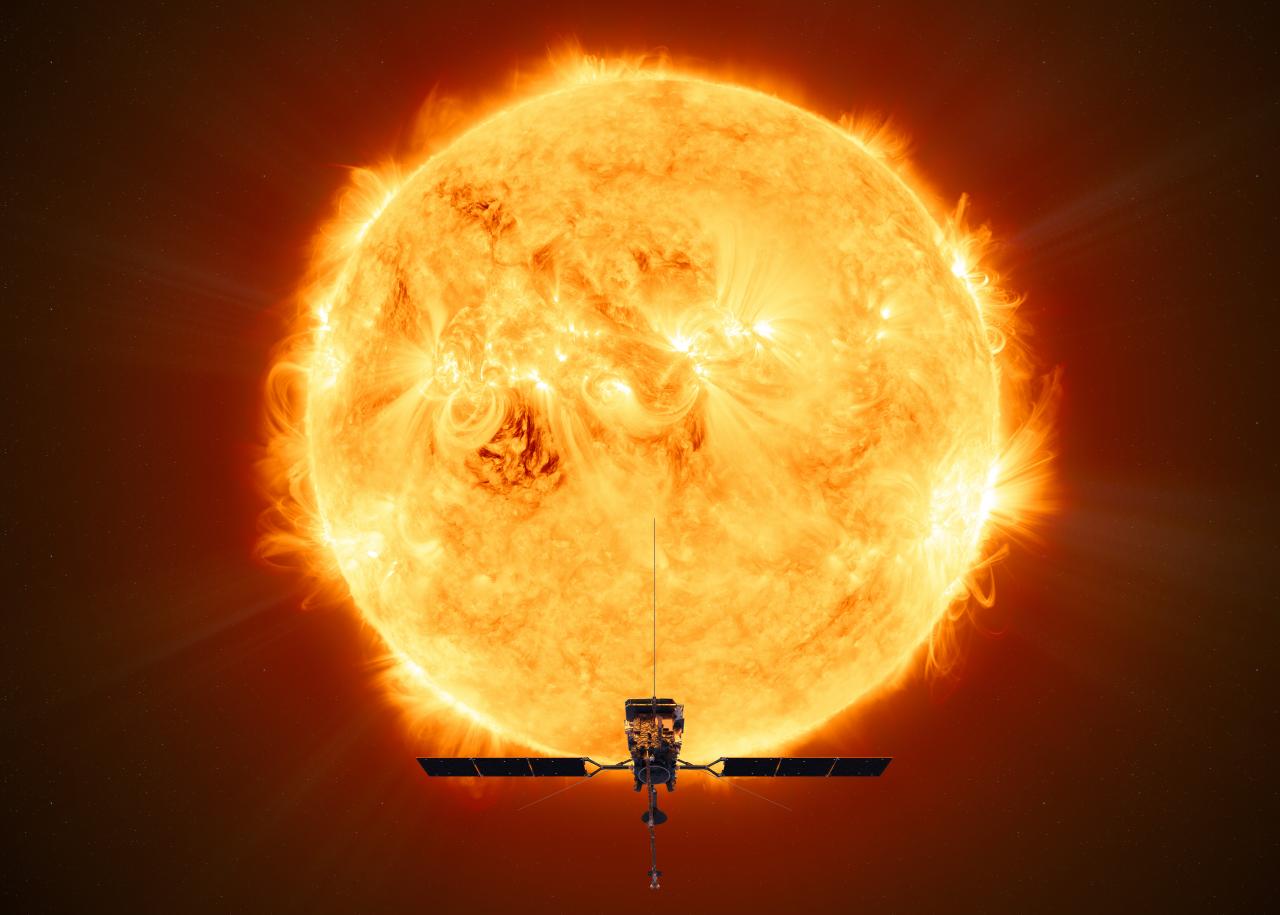
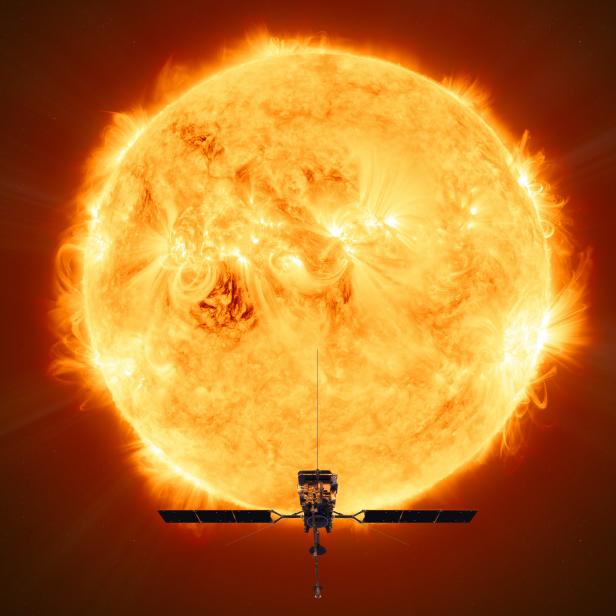
ESA's Solar Orbiter mission will face the Sun from within the orbit of Mercury at its closest approach.

ESA's Solar Orbiter mission will face the Sun from within the orbit of Mercury at its closest approach.

Photo by: ESA/ATG medialab

ESA/ATG medialab

Behold, the Sun as You’ve Never Seen It Before

The European Space Agency’s Solar Orbiter reached the halfway point between the Earth and the Sun to snap an amazing super-high-res picture. You can zoom in on the image to reveal the stunning details of the Sun’s surface. It’s like a Google Earth…but for the Sun.

June 09, 2022

The Solar Orbiter (affectionally known as SolO) launched in February of 2020 and will orbit the Sun (as the name implies) for seven years. The closest SolO will come to the Sun is about a quarter of the Earth’s orbit. That may not sound like it’s getting very close, but the heat at that orbit is so intense that SolO has to carry a protective heat shield, and its 21 scientific instruments were specifically designed to suffer the full blast of the Sun’s glare.

Speaking of instruments, to grab this amazing picture SolO used its Extreme Ultraviolet Imager. You might be more familiar with ultraviolet light as the kind of radiation that can give you a nasty sunburn if you don’t apply your sunblock. The scientists behind SolO chose this wavelength of light because it gives the cleanest give of the Sun’s surface, known as the chromosphere, and its thin-out atmosphere, known as the corona.
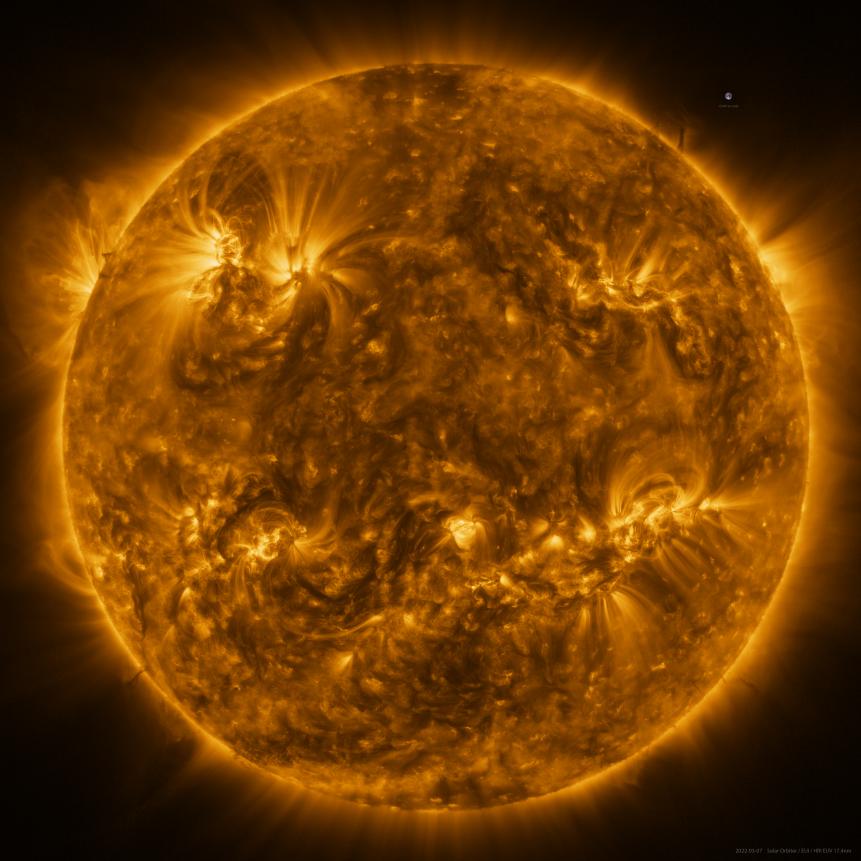
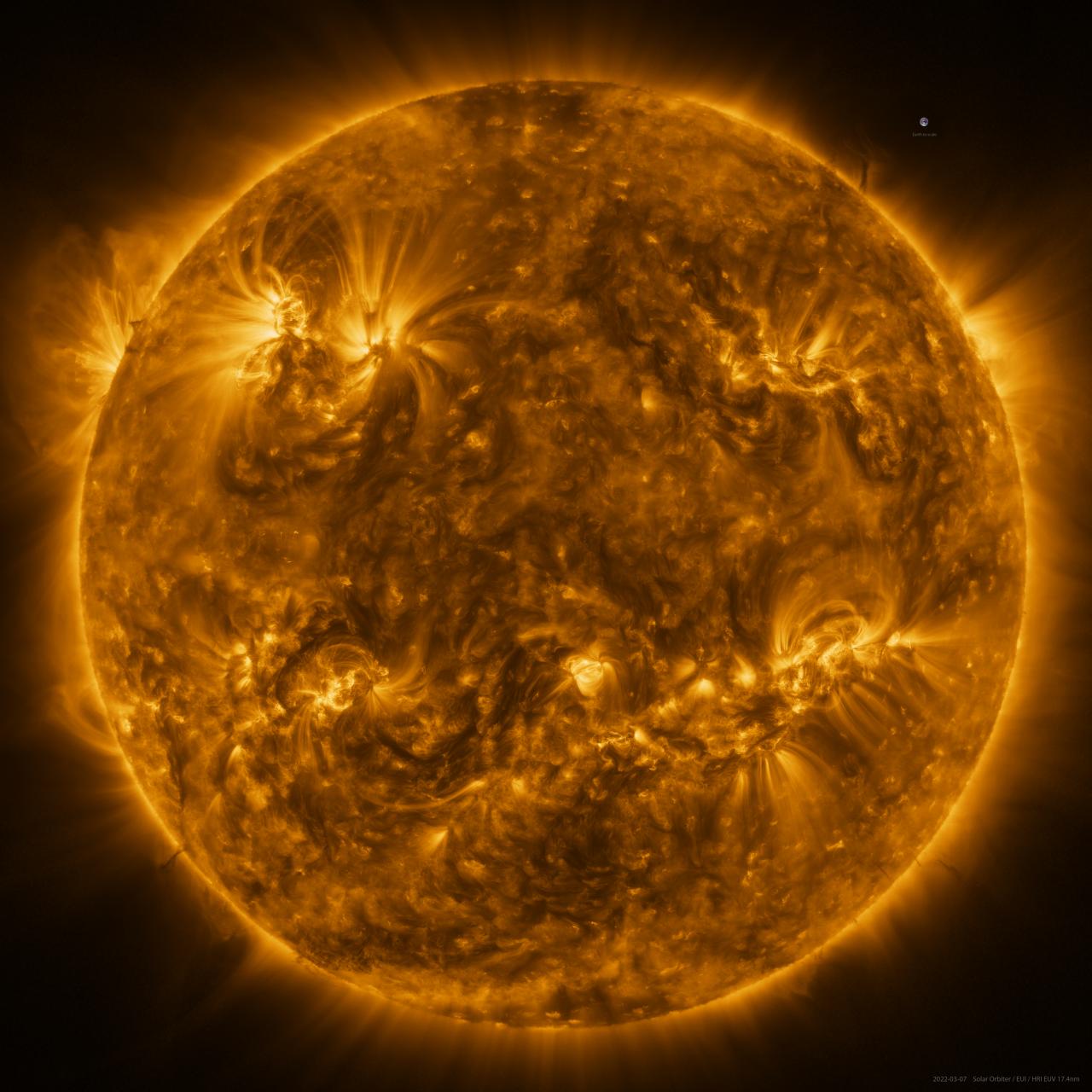
The Sun as seen by Solar Orbiter in extreme ultraviolet light from a distance of roughly 75 million kilometres. The image is a mosaic of 25 individual images taken on 7 March by the high resolution telescope of the Extreme Ultraviolet Imager (EUI) instrument. Taken at a wavelength of 17 nanometers, in the extreme ultraviolet region of the electromagnetic spectrum, this image reveals the Sun’s upper atmosphere, the corona, which has a temperature of around a million degrees Celsius.  In total, the final image contains more than 83 million pixels in a 9148 x 9112 pixel grid, making it the highest resolution image of the Sun’s full disc and outer atmosphere, the corona, ever taken.  An image of Earth is also included for scale, at the 2 o’clock position.

The Sun as seen by Solar Orbiter in extreme ultraviolet light from a distance of roughly 75 million kilometres. The image is a mosaic of 25 individual images taken on 7 March by the high resolution telescope of the Extreme Ultraviolet Imager (EUI) instrument.

Photo by: ESA & NASA/Solar Orbiter/EUI team; Data processing: E. Kraaikamp (ROB)

ESA & NASA/Solar Orbiter/EUI team; Data processing: E. Kraaikamp (ROB)

The Sun as seen by Solar Orbiter in extreme ultraviolet light from a distance of roughly 75 million kilometres. The image is a mosaic of 25 individual images taken on 7 March by the high resolution telescope of the Extreme Ultraviolet Imager (EUI) instrument.

In the image, you can see how violent and raucous the Sun can really be. At roughly the 2 o’clock position you can spot a dark filament. This is what’s called a prominence, which is an extension of the Sun that will likely completely erupt from the surface any day now. Magnetic fields tangle together to form these filaments, and when they snap like over-stretched rubber bands they release their energy in a quick burst, driving the prominence.

Also in the image, you can see the swirling bands of the Sun’s lower atmosphere. The Sun is incredibly hot on the inside (because of fusion), but incredibly cold on the outside (because of space). This makes the physics of the plasma inside the Sun act exactly like a boiling pot of water. Pockets of plasma in the center of the Sun heat up, expand, and rise to the surface. Once they touch the surface, however, they cool off, slinking back down into the depths.
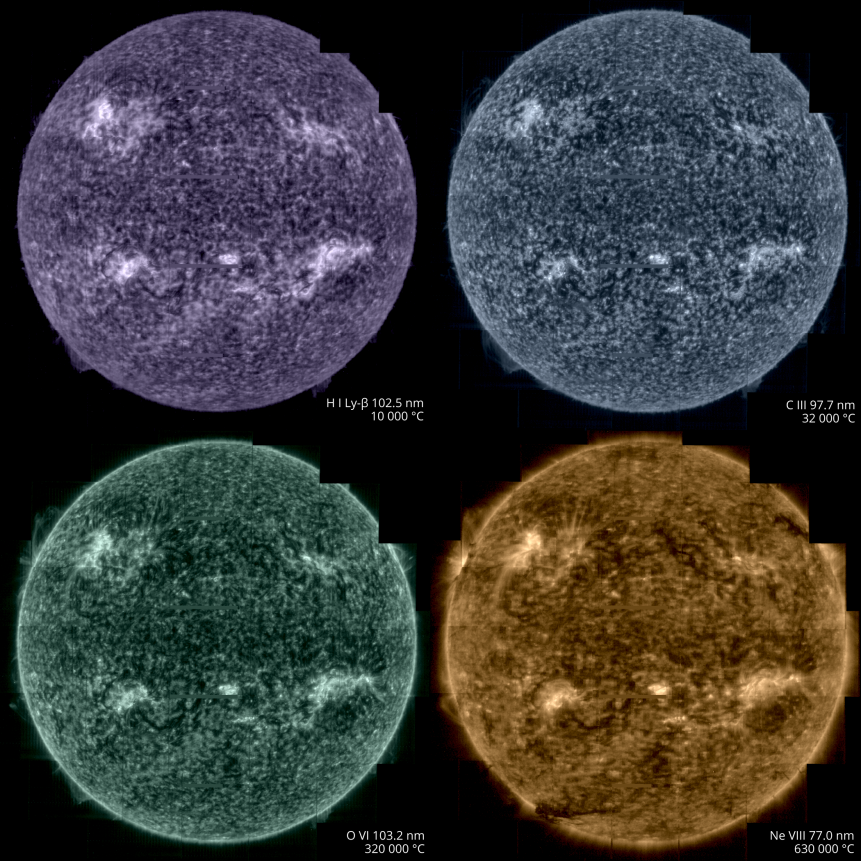
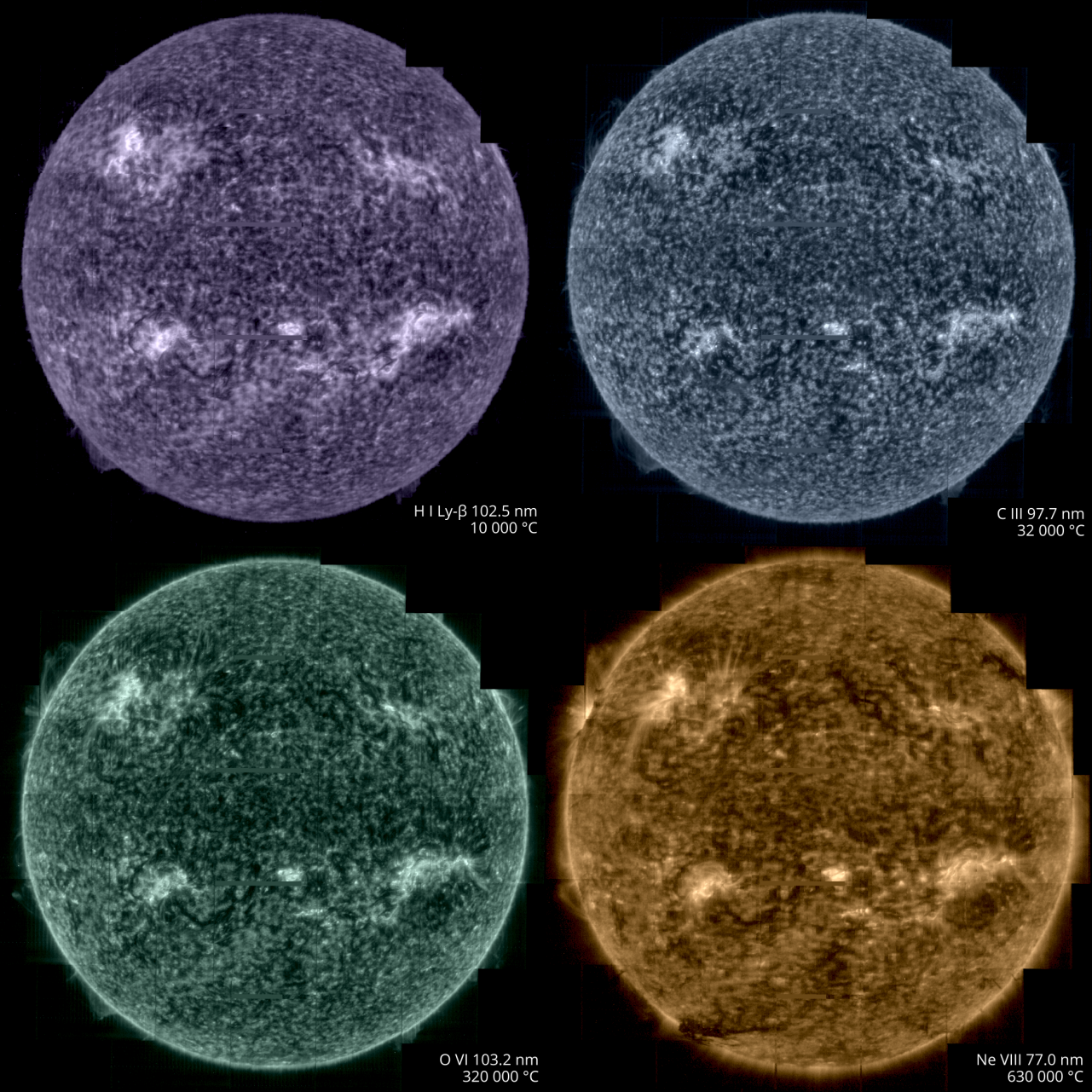
Solar Orbiter took images of the Sun on 7 March, from a distance of roughly 75 million kilometres, using its Spectral Imaging of the Coronal Environment (SPICE) instrument. SPICE takes simultaneous “spectral images” at several different wavelengths of the extreme ultraviolet spectrum by scanning its spectrometer slit across a region on the Sun. The different wavelengths recorded correspond to different layers in the Sun’s lower atmosphere. Purple corresponds to hydrogen gas at a temperature of 10 000°C, blue to carbon at 32 000°C, green to oxygen at 320 000°C, yellow to neon at 630 000°C. Each full-Sun image is made up of a mosaic of 25 individual scans. It represents the best full Sun image taken at the Lyman beta wavelength of ultraviolet light that is emitted by hydrogen gas.

Solar Orbiter took images of the Sun on 7 March, from a distance of roughly 75 million kilometres, using its Spectral Imaging of the Coronal Environment (SPICE) instrument. SPICE takes simultaneous “spectral images” at several different wavelengths of the extreme ultraviolet spectrum by scanning its spectrometer slit across a region on the Sun. The different wavelengths recorded correspond to different layers in the Sun’s lower atmosphere.

Photo by: ESA & NASA/Solar Orbiter/SPICE team; Data processing: G. Pelouze (IAS).

ESA & NASA/Solar Orbiter/SPICE team; Data processing: G. Pelouze (IAS).

Solar Orbiter took images of the Sun on 7 March, from a distance of roughly 75 million kilometres, using its Spectral Imaging of the Coronal Environment (SPICE) instrument. SPICE takes simultaneous “spectral images” at several different wavelengths of the extreme ultraviolet spectrum by scanning its spectrometer slit across a region on the Sun. The different wavelengths recorded correspond to different layers in the Sun’s lower atmosphere.

In other words, the Sun is boiling.

This constant back-and-forth, up-and-down motion drives heat from the inside of the Sun to the outside, powering the chaos on the surface and the release of prominences.

SolO will spend its seven-year mission studying the structure of the Sun’s surface and atmosphere, trying to understand the complex physics happening there. Perhaps the biggest mystery is why the atmosphere (the corona) is so much hotter than the surface. You would normally think it would be the opposite, but something funny is happening on the Sun to drive heat into its outermost reaches.
Journey Through the Cosmos in an All-New Season of How the Universe Works

The new season premieres on Science Channel and streams on discovery+.

Paul M. Sutter is an astrophysicist at Stony Brook University and the Flatiron Institute, host of Ask a Spaceman and Space Radio, and author of How to Die in Space.

Next Up

Get Ready for Puppy Bowl XXII on Animal Planet!

Puppy Bowl XXII premieres Sunday, February 8, 2026, at 2:00PM ET/11:00AM PT with more adoptable puppies from shelters and rescues than ever before.

Get Ready for Puppy Bowl XXI on Animal Planet!

Puppy Bowl XXI premieres Sunday, February 9 at 2P ET/11A PT with more adoptable puppies from shelters and rescues than ever before.

Get Ready for Puppy Bowl XX on Animal Planet!

Puppy Bowl XX premieres Sunday, February 11 at 2P ET/11A PT with more adoptable puppies from shelters and rescues than ever before.

Shark Week: The Podcast - Why is Tagging Baby Great White Sharks So Important?

Luke Tipple speaks with Dr. Riley Elliott, a marine biologist from New Zealand who recently tagged baby great white sharks, which are rarely seen in the wild. They talk about how climate change is affecting shark pupping grounds, why fishers are wrong to think there are “too many sharks,” and about Dr. Elliott’s Great White App, which allows users to track great white sharks in the ocean.

Nature from Above: The Art of Aerial Photography

I’ll never forget the first time I went up in a small plane. Technical considerations aside, I had a million thoughts going through my mind.

Curiosity Daily: Glass Rain Dinosaur Pain, Snarge Science, Human Skin Cyborg

A new archeological discovery might be from the day of the big asteroid strike that took down the dinosaurs, bird goo is helping us understand airplane accidents, and find out about the most human-like robot finger you’ve ever seen.

Curiosity Daily Podcast: Healing Hearing Hairs, Sun Phones, Chicken Gods

Hear about a new treatment that may be able to reverse hearing loss, how new solar energy storage technology could eventually power our phones, and the surprisingly grand history of chickens.

Curiosity Daily Podcast: Fusion: Homeward Bound, The Last Light Show, Burnout Blues

Today, you’ll learn about how the next step in nuclear fusion is actually a real estate question, how the death of our sun would be a beautiful thing to see if we were around to witness it, and how an athlete’s desire for perfection can lead to them burning out with their sport altogether.

Shark Week: The Podcast - Jeff Kurr on Filming a Life-Threatening Shark Encounter

Luke Tipple is joined by Emmy award-winning and longtime Shark Week filmmaker, Jeff Kurr to discuss his new documentary, Great White Open Ocean, and the life-threatening shark encounter captured in his film and seen in recent news.

Curiosity Daily Podcast: How to Know You’re Running Low on Vitamins

Learn about how to tell when your body is running low on key vitamins; how Neanderthals mourned their dead; and why you should NOT pre-rinse your dishes before putting them in the dishwasher.

Related To: