


Curiosity Daily Podcast: What Science Says About Putting 2 Spaces After a Period
Learn about how clocks and lightbulbs changed human health, with author and materials scientist Ainissa Ramirez. Plus: learn about that time a bunch of birds became milk bottle thieves and whether you should put one or two spaces after a period.
February 25, 2021
Episode Show Notes:
The time a bunch of birds became milk bottle thieves by Cameron Duke
- Aplin, L. M., Farine, D. R., Morand-Ferron, J., Cockburn, A., Thornton, A., & Sheldon, B. C. (2014). Experimentally induced innovations lead to persistent culture via conformity in wild birds. Nature, 518(7540), 538–541. https://doi.org/10.1038/nature13998
- Aplin, L. M., Sheldon, B. C., & Morand-Ferron, J. (2013). Milk bottles revisited: social learning and individual variation in the blue tit, Cyanistes caeruleus. Animal Behaviour, 85(6), 1225–1232. https://doi.org/10.1016/j.anbehav.2013.03.009
- Boogert, N. (2014, December 4). Milk bottle-raiding birds pass on thieving ways to their flock. The Conversation. https://theconversation.com/milk-bottle-raiding-birds-pass-on-thieving-ways-to-their-flock-34784
Should You Put One or Two Spaces After a Period? by Cody Gough
- Hamblin, J. (2018, May 11). The Atlantic. The Atlantic; theatlantic. https://www.theatlantic.com/science/archive/2018/05/two-spaces-after-a-period/559304/
- Johnson, R. L., Bui, B., & Schmitt, L. L. (2018). Are two spaces better than one? The effect of spacing following periods and commas during reading. Attention, Perception, & Psychophysics, 80(6), 1504–1511. https://doi.org/10.3758/s13414-018-1527-6
- Douglas, N. (2018, May). No, You Still Shouldn’t Put Two Spaces After a Period. Lifehacker; Lifehacker. https://lifehacker.com/no-you-still-shouldnt-put-two-spaces-after-a-period-1825662114
More from Ainissa Ramirez:
- Pick up "The Alchemy of Us: How Humans and Matter Transformed One Another" on Amazon: https://amzn.to/2MyB4l8
- Ainissa's website: https://www.ainissaramirez.com/
- Ainissa Ramirez on Twitter: https://twitter.com/ainissaramirez
Subscribe to Curiosity Daily to learn something new every day with Cody Gough and Ashley Hamer. You can also listen to our podcast as part of your Alexa Flash Briefing; Amazon smart speakers users, click/tap “enable” here: https://www.amazon.com/Curiosity-com-Curiosity-Daily-from/dp/B07CP17DJY
See omnystudio.com/listener for privacy information.
Next Up

Get Ready for Puppy Bowl XXII on Animal Planet!
Puppy Bowl XXII premieres Sunday, February 8, 2026, at 2:00PM ET/11:00AM PT with more adoptable puppies from shelters and rescues than ever before.

A Guide to Defending the Earth
Let’s say one day astronomers announce that our worst nightmare has come true: a large object is headed towards the Earth with a significant chance of impact. What do we do?

Scientists Watch as Stars Quake
The European Space Agency’s Gaia spacecraft has managed to watch stars tremble, their light subtly changing as starquakes ripple through their surfaces. Which is pretty cool, because Gaia wasn’t even designed to do it.
Shark Week: The Podcast - How To Have A Career in Shark Science
Shark Week’s Luke Tipple tackles the question “How can I work with sharks?” alongside two experts in the field – and their answers are not always the obvious ones. Luke is joined first by Kelly Link, Associate Curator of the Georgia Aquarium who talks about what it’s like to be an aquarist, how it differs from field work, and how to get yourself noticed. The second guest is Dr. Neil Hammerschlag who goes into detail on what it takes to become a prominent scientist, and what other paths you can take if a PhD isn’t for you. And at the end, researcher Sierra stops by to tell us about the world’s smallest shark.
Why We Know Nothing about Dark Matter and Dark Energy
Welcome to the era of precision cosmology…where we’ve managed to very precisely measure everything we don't know about the universe.

An Astronomical Review of “Don’t Look Up”
In our annual New Year’s family tradition of struggling to stay awake until midnight, we decided to watch “Don’t Look Up,” the Adam McKay satire starring Leonardo DiCaprio, Jennifer Lawrence, and other fabulously good-looking people.
Shark Week: The Podcast - Undiscovered Sharks and the State of the Ocean
Luke Tipple invites “The Lost Shark Guy,” Dr. Dave Ebert, who is personally responsible for finding dozens of shark species that were either previously unknown to science or thought to be extinct. He and Luke discuss why shark populations are a direct indicator of how healthy the ocean is, how to find undiscovered sharks, and why diversity in sharks is essential for marine life.
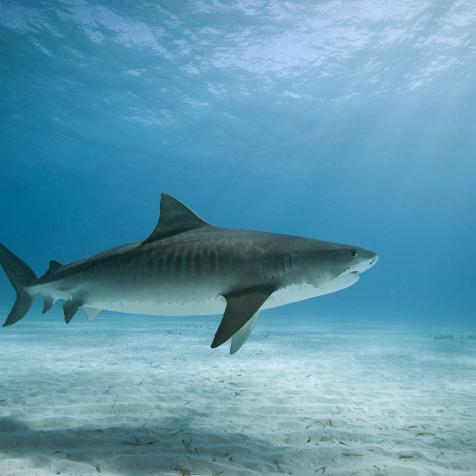
Shark Week: The Podcast - How Did a Shark Encounter Survivor Become an Advocate for Their Protection?
Shark Week’s Luke Tipple welcomes professional photographer Mike Coots, who lost his leg to a tiger shark attack when he was only 18. But after his horrific injury, he came to love sharks, and became a lifelong advocate for their safety. Luke and Mike discuss his career, his love for photographing sharks, and how to positively approach the big life-changing moments that can happen to any of us.

Shark Week: The Podcast - Do Scientists Need to Kill Sharks?
Host Luke Tipple welcomes two guests to discuss how researchers can kill sharks in the name of science – and whether they need to at all. The first is Dr. Neil Hammerschlag, shark researcher and founder of Atlantic Shark Expeditions, and an expert on data-gathering in the field. He’s followed by explorer Fred Buyle, a world-record-breaking freediver whose innovative methods of shark tagging are explored. Plus, our researcher Sierra tells us about how a 50-year study changed our understanding of tiger sharks – and much of the work wasn’t even done by scientists.


Curiosity Daily Podcast: Nobel Prize Winner Richard Thaler on How Nudge Changed the World — Plus, Squirrel-Inspired Robots
Nobel Prize-winning economist Richard Thaler explains how “Nudge” has changed the world. Plus: squirrel-inspired robots!