


All Space Articles
Showing 421 - 435 of 491 results
Curiosity Daily Podcast: Moviegoers Blink in Sync, Rain on the Sun, and Why Flamingos Stand on One Leg
Learn about a new discovery about rain on the sun; why flamingos stand on one leg; and why you blink the way you do when you’re watching a movie.
Curiosity Daily Podcast: Beliefs That Boost Grades, Optimism for Better Sleep, and Planets More Habitable Than Earth
Learn about why there could be planets even more habitable than Earth; an online class that boosted grades by changing students’ beliefs; and why optimism may lead to better sleep.
Curiosity Daily Podcast: How Loud Is the Sun?
Learn about a simple way to reduce your internet carbon footprint; how brain images can make you more likely to believe fake science; and how loud the sun is.
Curiosity Daily Podcast: Game Transfer Phenomena (w/ Angelica Ortiz de Gortari) and the Methane Spike on Mars
Learn how a newly detected methane spike on Mars may change our understanding of the red planet; and how you can participate in a new research study on game transfer phenomena, with researcher Angelica Ortiz de Gortari.

Curiosity Daily Podcast: Zero G Romance, Our Sixth Sense, Oinking at A.I.
Today, you’ll learn about why studying human intimacy in space is necessary for humanity, the mysterious sixth sense human beings have, which is not seeing dead people, and how researchers used artificial intelligence to figure out a way to speak pig.
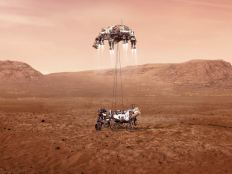
NASA's Biggest 2021 Milestones
From making history on Mars to supersonic aircraft, NASA continues to astound us with science from this past year.

Curiosity Daily Podcast: Explorers Club - George Nield
Today, we’re talking to Explorers Club member, Dr. George C. Nield. Dr. George C. Nield is currently the Associate Administrator for Commercial Space Transportation at the Federal Aviation Administration (or FAA).
Curiosity Daily Podcast: NASA's InSight Lander Mars Mission, the Chicken or the Egg, and Common Synesthesia
Cody Gough and Ashley Hamer discuss the following stories from Curiosity.com to help you learn something new in just a few minutes:

We Might Smell Life Before We See It
It’s a tough game to determine if a distant planet orbiting some nameless star hosts life on it or not. You can’t just walk up to it and start flipping over rocks or poking into the dirt. You can only use your telescopes, and the planets are so extremely distant that you can’t see the surface itself.
Curiosity Daily Podcast: Exercising for Different Body Types, New England Vampire Panic, Non-Vertical List Benefits, and Constellations on Mars
Learn about how your body type affects the way you should exercise; the New England Vampire Panic; what our constellations would look like if we saw them from Mars; and the benefits of writing a better, non-vertical list to organize your thoughts.
Curiosity Daily Podcast: Stanford Technique for Picking Creative Ideas, Why Whales Are So Big (But Not Bigger), and the First Medical Diagnosis and Treatment in Space from Earth
Learn about how doctors on Earth diagnosed and treated an astronaut’s medical problem in space for the first time; a new study that explains why whales are so big, but not bigger; and a Stanford technique for getting better at picking creative ideas.
Curiosity Daily Podcast: Personalities Associated with Certain Names, Working Less to Save the Earth, and Superbolts
Learn about the big impact we could have on our planet by cutting work hours; the strange behavior of superbolts of lightning; and, which personalities people associate with the sounds of certain names.
Curiosity Daily Podcast: Why You’d Choose Your Biases Over Money, Coldest Inhabited Place on Earth, and Dark Fluid
Learn about why your biases are so strong, you’d choose them over making money; a new theory that “dark fluid” might mean that dark matter and dark energy are the same weird substance; and Oymyakon, one of the coldest places on Earth where people continuously live.
Curiosity Daily Podcast: Prince Rupert’s Drop, Why Earth’s Core Is Younger Than Its Surface, and Newborn Babies May Be Super Smart
Learn why a Prince Rupert’s drop is both super-fragile and virtually unbreakable; why researchers think newborn babies are a lot smarter than they look; and why Earth’s core is younger than its surface.
Curiosity Daily Podcast: How Music Affects Your Work, Damage from Muffled Hearing, and Earth’s Gigantic Atmosphere
Learn about why the Earth’s atmosphere extends beyond the moon; whether you should listen to music while you work; and whether your muffled hearing after a concert means you damaged your ears.